The Orient–Occident Civilizational Binary
The SympathizerThe Orient–Occident Civilizational Binary is a way of dividing the world into supposedly opposed civilizations, and in the novel it becomes both a theory of war and a tool for classifying people. Richard Hedd presents the division as an explanation of political behavior and cultural character; the General learns to use it to win favor in an American room; and the narrator reveals how its neat categories misrepresent the people they claim to explain. The concept’s significance lies not only in the stereotypes it produces, but in the unequal power to make those stereotypes sound like knowledge.
Hedd’s categories of Vietnamese identity
In Richard Hedd’s account, Vietnamese people are not encountered first as individuals but sorted into political types. He describes the average Viet Cong fighter as an idealistic young man deceived by communism, someone who would recognize America as a friend if he understood its true nature. The narrator recognizes that this formulation does not describe him exactly, yet does describe him by reducing him to a type. Hedd’s generalization converts a political opponent into someone whose disagreement can be explained as error rather than as a considered response to American power.
A second passage in Hedd’s book offers a different classification: the Vietnamese radical intellectual, familiar with Western thinkers and capable of asking why the rights celebrated by Western civilization have not been extended to his people. Hedd calls this figure irretrievably committed to the radical cause. The narrator accepts the accuracy of the description as applied to himself, but the surrounding contrast matters: elsewhere, Hedd identifies young Vietnamese who admire America as the key to South Vietnam’s freedom, arguing that they may eventually replace generals trained by the French. The categories divide people according to their relationship to American influence, making political allegiance appear to determine whether a Vietnamese person is lost or available for cultivation.
The narrator’s image of himself as composed of many pages challenges the ease of Hedd’s classification. A person may fit more than one of the book’s descriptions, while Hedd appears to regard the narrator as a single sheet, readily legible and mastered. The narrator’s resolve to prove otherwise makes reading itself part of the conflict: Hedd claims authority by interpreting Vietnamese people, while the narrator studies Hedd’s language and prepares to turn that knowledge back upon its author.
A civilizational explanation of war
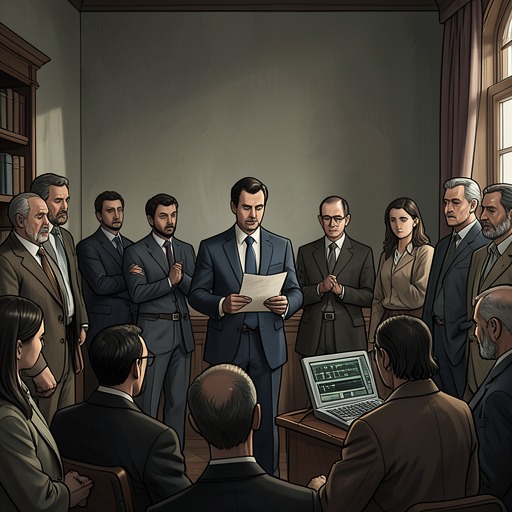
At the General’s meeting with American political and military figures, the binary becomes an explicit account of the Cold War. The General tells Richard Hedd that the conflict is fundamentally between Orient and Occident, and repeats Hedd’s claim that the Soviet Union is Asiatic in character because it has not learned Western ways. This agreement is not spontaneous: the narrator has summarized Hedd’s arguments for the General in preparation for the meeting. The General’s apparent endorsement therefore shows how the framework can be deployed as political performance, with an exiled South Vietnamese leader presenting himself as culturally aligned with his American listeners.
Richard Hedd’s account of military defeat extends the same division into the conduct of war. He argues that American generals knew the value of Japanese strategies but were unable or unwilling to wage a war of obliteration, and that a war of attrition therefore looked like weakness to the Oriental. He then makes the claim that life is cheap in the Orient and that Eastern philosophy does not value life as highly as Western thought does. A vast and varied region is made to signify a single attitude toward human life, and military outcomes are explained through an alleged civilizational character rather than through the particular history and politics of the conflict.
The General briefly supplies a counterpoint by observing that the Orient’s inexhaustible resource is people. Yet when asked to assess Hedd’s argument, he publicly agrees that the truth is uncomfortable. The narrator, after drinking through the dinner, contests the claim: life is valuable to the Oriental, he argues, but invaluable to the Westerner. Richard Hedd responds approvingly, and the exchange ends without dismantling the categories that made the argument possible. The narrator’s distinction exposes the binary’s asymmetry: the Westerner is granted a heightened valuation of life, while the Oriental is described through a supposedly lesser one. His reply turns that hierarchy back on itself, but its polished symmetry also shows how readily the terms of the debate can absorb a challenge without dissolving the framework.
The Western gaze and the returned gaze
The narrator’s account of the dinner broadens the problem beyond Hedd’s book. The General, like the narrator, understands that a nonwhite person must be patient with white people and attentive to their differences. Immigrants learn American language, humor, food, films, gestures, and habits through everyday contact; they may even avoid speaking their own language in white people’s presence because doing so makes those people uneasy. The narrator describes this accumulated observation as an anthropology of the American people, conducted by people whom Americans do not recognize as observers. Their reports travel privately to relatives in letters and postcards, reversing the familiar arrangement in which the West studies and represents the East.
That reversal does not grant the narrator complete knowledge or freedom from the gaze he analyzes. He describes the continual self-checking that follows from wondering how white people see him, and distinguishes what immigrants have learned from what remains inaccessible: the customs of elite spaces such as the gathering hosted by the Congressman. At the dinner, the General stays carefully alert to the room and avoids giving offense. The scene shows that knowledge is shaped by unequal intimacy: Vietnamese exiles have studied white American life closely, while their own histories remain subject to American interpretation.
Exile, masculinity, and the limits of the binary
The binary also has consequences beyond books and formal political argument. Among the exiled soldiers, economic displacement and cultural change are felt through family roles: wives who once existed in their husbands’ memories as idealized figures now work, while children master English faster than their fathers and answer back in a foreign tongue. The men may interpret these changes as Western contamination. The narrator suspects that their nostalgia has altered their memories, since they did not speak so fondly of their wives in Vietnam. The contrast shows how the language of cultural difference can turn the ordinary pressures of exile into evidence of a civilizational threat.
In a separate conversation, Bon describes American intervention and rescue as two stages in the same injury. He says that the Americans promised freedom in exchange for fighting their way, taking their money, and giving them their women, then rescued the refugees after defeat while leaving them stripped of power and voice. His account links the loss of military purpose to the loss of family and national roles; it is not simply a claim about an Eastern or Western character. The General’s men likewise appear in two sharply different forms: in civilian jobs they are dispersed among busboys, gardeners, custodians, and the unemployed, but in surplus-store uniforms they stand straight, march, and become visible as an army again. The change suggests that identity is made in circumstances, not fixed by a civilizational essence.
The Orient–Occident Civilizational Binary thus operates at once as explanation, stereotype, and political instrument. Richard Hedd uses it to interpret Vietnamese resistance and military defeat; the General adapts it to an American audience; and the narrator exposes the power relations beneath its confident divisions while recognizing that he cannot simply step outside them. Across the dinner, the exiles’ private observation of white America, and their struggle to recover social and military standing, the novel sets abstract civilizational types against people whose loyalties, histories, and losses exceed the categories imposed upon them.